
 back
to Caleb Deschanel article
back
to Caleb Deschanel article

published by
The Words Group
700 Sleater-Kinney Road
Suite 303-B
Lacey, Washington
98503 USA

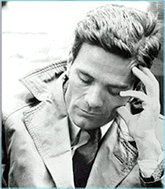
Through the Eye of a Needle
Pasolini's "Gospel According to St. Matthew"
The Gospel According to St. Matthew is a little-seen
1964 masterpiece by the controversial Italian director Pier Paolo Pasolini,
a film that veteran British critic Alexander Walker was not alone in proclaiming
"grips the historical and psychological imagination like no other
religious film I have ever seen."
And there have been others. Many others. According to Roy Kinnard and
Tim Davis' "Divine Images: A History of Jesus on the
Screen," some 47 actors have played Christ between
1897 and 1989, everyone from Jeffrey Hunter and Max Von Sydow to Willem
Dafoe and even Zalman King. Yet none of their films reached the heights
that Pasolini's did.
Pasolini was a poet and filmmaker, a Catholic turned atheist and a committed
Marxist who got into trouble with both the party and the church. Yet this
man's "St. Matthew" (still available on video) was justly considered
to be one of the most spiritual films ever made. It won the grand prize
of the International Catholic Film Office (as well as two awards at Venice)
and was one of 45 films recommended by the Vatican in 1996 in honor of
the centenary of cinema.
That was an action that fellow director Franco Zeffirelli (whose films
did not make the list) huffily condemned because the director had been
"not only mediocre but also an atheist." Yet no zealous true
believer could have made a more effective work on the subject than this
dynamic and respectful film, and seeing it again in anticipation of Gibson's
epic leads to a new appreciation of how improbable and complete its success
was.
For not only was Pasolini an implausible filmmaker for the subject matter,
his film is an unlooked-for amalgam of disparate elements and influences
not guaranteed to blend smoothly. Yet — one is tempted to say miraculously
— they do.
 Nontraditional
music and setting
Nontraditional
music and setting
In the beginning, as they had to be, were the words. The lines in Pasolini's
spare Italian-language screenplay are all from Matthew, and the director
has found ways to make sentiments like "man shall not live by bread
alone" and "the poor shall you always have with you" resound
with the power of something spoken for the first time.
If the words are traditional, the film's music is not. Yes, there is Bach,
but there is also the forceful African Missa Luba and the blues of Son
House. Odetta's version of "Motherless Child" makes an unexpected
appearance, and the music Prokofiev wrote for the German slaughter of
babies in Eisenstein's "Alexander Nevsky" fits perfectly behind
Herod's massacre of the innocents.
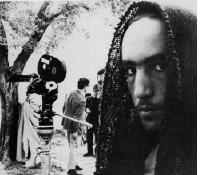
Even more nontraditional is the bleak setting of Calabria in southern
Italy, which Pasolini chose after scouting and rejecting locations in
Israel. Stunningly photographed in black and white by Tonino Delli Colli,
the parched hill towns and ruined buildings of the area seem to be part
of the same universe as ancient Palestine, donkeys and all.
Pasolini's key decision was to shoot this story in the great Italian tradition
of neo-realism, using nonprofessional actors for all the roles and selecting
a young Spanish student named Enrique Irazoqui to play his charismatic,
active Christ.
Determined to give Christ's words their full weight, Pasolini had Irazoqui's
voice dubbed by actor Enrico Maria Salerno. And he did give cameos to
people he knew — the novelist Natalia Ginzburg played Mary of Bethany,
and Pasolini's own mother played Mary grieving at the cross. But what
stays with you more are the marvelous faces of local people, each one
a book in itself, that give this story exceptional resonance.
Because simplicity is his watchword, there is something elevating about
Pasolini's conception, something of the power and deeply moving nature
of the great silent films in what he has done. Everyone in the narrative
seems to sense that they are part of what believers will eventually come
to call the greatest story ever told.
As Christ's life unfolds from a clearly surprised Joseph learning that
his wife is pregnant to the Crucifixion and Resurrection, Pasolini does
not shy away from unusual choices. His Angel Gabriel is a young girl,
and his Salome is an innocent rather than a practiced temptress. The director
treats Christ's miracles with an effective and almost journalistic matter-of-factness,
and the film is aware of yet finally indifferent to the involvement of
the Jews. That is simply not the story it wants to be telling.
 A
forceful presence
A
forceful presence
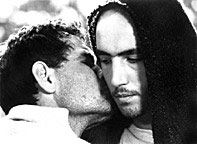
The story "St. Matthew" does want to recount is of an activist,
liberation theology-influenced Christ, always on the move perhaps because
he was conscious of how short his time was. Looking both ethereal and
real, this Christ is an uncompromising idealist with burning eyes and
an intense gaze, an enemy of hypocrisy and cant who furiously drives the
money-changers out of the temple. When he says "he that loves his
mother and father more than me is not worthy" and insists "he
that loseth his life for me shall find it," his presence is so forceful
he all but compels agreement in his listeners.
Because he wanted to, in his own words, "re-mythicize" the events
of Christ's life, because of the paradox that "I, a nonbeliever,
was telling the story through the eyes of a believer," Pasolini ended
up giving this story an unshakable sense of actuality. We experience that
much-recounted life as if we were watching it for the very first time,
almost in a newsreel, as if it were something that happened to real people
at a real moment in time.
Pasolini may not have believed, but the dynamic power of belief is behind
the lasting work he does here. Unwilling to be pigeonholed either aesthetically
or philosophically, Pasolini had a thoughtful response when asked how
a Marxist could make a film like "The Gospel According to St. Matthew."
He called it "a reaction against the conformity of Marxism. The mystery
of life and death and of suffering — and particularly of religion
is something that Marxists do not want to consider. But these are and
always have been questions of great importance for human beings."
- K. T.
back
to Caleb Deschanel article