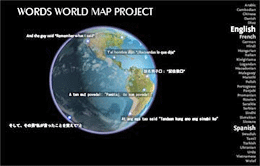 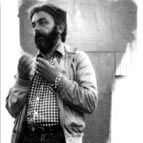
images: sample Global Map Project page; Isam Khoury narrates The Words in Arabic
Nets of Silicon, Webs of Flesh*
The Words Global Map Project 2010, Reaching an Ever-Shrinking World
"With so much functionality increasingly being delivered to smaller, cheaper devices, mobile computing is poised to fundamentally alter our relationship to computing and how we access the World Wide Web." - PAUL BARKER New York Times Magazine, May 2009
"The sense is that in data is the emerging appearance of the divine. If our consciousness is a
God-consciousness (or God centered consciousness) our interpretation will be positive and we will have grasped the essence through the appearance of the divine. If our consciousness is
not a God-consciousness, we are disconnected from the essence. Each time we rise one level to see it pointing to God, our actions will be virtuous and we will bring Godliness into the world. Bringing Godliness into the world is our function." - ROBERT HARALICK City University New York
"Cyberspace offers us a new way to manifest the word of God, love, connection, justice, empathy, and divine care. This will happen if we consciously work to create implementations of the medium that reflect these injunctions. Understanding the role of cyberspace has become an intrinsic responsibility, an irretrievable mandate and starting point. With this perspective firmly in hand, our instrumental use of this rapidly developing medium is enlivened by the knowledge that the World Wide Web can serve as an expression of the divine spirit speaking to all creation. Through our creative process, as we respond to this medium and its users, we open the possibility of working with science to further spiritual growth worldwide." - JENNIFER COBB Cybergrace, The Search for God in the Digital World
The Global Map Project 2010
The spread of cell phone technology is something that is rapidly transforming the world we live in. Information is spread and interacted with on a scale that was previously unimaginable and unattainable. Consider the fact that in some developing countries as many users access the Internet from mobile devices, such as cell phones, as in the developed world, and in many areas surpass Western figures. A new era has arrived, shrinking the globe, and granting access to a great audience of "whosoevers" that are being drawn into what Jennifer Cob describes as "nets of silicon." *
Once the domain of the privileged, technology is now common in villages far removed from city life, where even peasant cultures are accessing the Internet. New York writer, Maria Wang, described this dramatically, recounting her return to China earlier this year:
"When I left my province in China for the United Sates, I was leaving behind considerable poverty. Ten years later I returned to find the same farmers pushing wheel borrows of straw and manure, all the while updating their cell phones every six months."
- MARIA WANG New York Times, March 2008
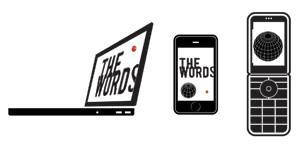 In the summer of 2009, a team of designers spread out between New York, Olympia, San Francisco, and Los Angeles, met in a web conference to discuss new methods to take advantage of this growing reality. The centerpiece of the discussion was how, in the very near future, the Internet as we currently know it will become a far more interactive and personal medium, one that will impact not only the immediate audience of users, but a growing number of less literate and even illiterate users with cell phone technology that is voice recognition and image driven. From this first meeting the following points were identified, three immediate and one future guidepost emerging from the Global Map Project: In the summer of 2009, a team of designers spread out between New York, Olympia, San Francisco, and Los Angeles, met in a web conference to discuss new methods to take advantage of this growing reality. The centerpiece of the discussion was how, in the very near future, the Internet as we currently know it will become a far more interactive and personal medium, one that will impact not only the immediate audience of users, but a growing number of less literate and even illiterate users with cell phone technology that is voice recognition and image driven. From this first meeting the following points were identified, three immediate and one future guidepost emerging from the Global Map Project:
1) To create an intuitive map that allows users to visualize their area of the world. Where GPS technology is combined with the mobile device in use, assist the user to locate their language position.
2) To map out a series of icons that will allow the user access to audio narrations of The Words in their language. The same set of icons would also assist the user to download the narration when MP3 is part of the device. Icons would also direct the user to text versions when requested.
3) To form a technical response team to assist use of the Global Map Project. Offer technical support and new resources as this project goes live and becomes viral.
4) Explore new and emerging technologies, VRS, single-unit players, etc., to imagine ways to reach those outside even the current footprint of mobile Internet and computer use. Be open to new methods and new ways of thinking when it comes to imagining what missions will be like in the coming half-decade.
 Blessed are they that hear the word of God... Blessed are they that hear the word of God...
Where literacy is an issue, we are enhancing the world map with visual navigation, using simple, easily understood icons that indicate whenever audio versions are available. Narrations and music on The Words site can be played or downloaded to phones. The future generation of phones, even in the developing world, will dual function as MP3 players. Once downloaded, audio can be outputted to a laptop and burned to CD, spreading the content outside of single use to a wider audience, truly viral. Two, three years ago, this might have seemed farfetched. Not any more. A project is already in development to create audio content between Los Angeles and Karachi, and then see that content spread in marketplaces.
The coming wave
"The next generation of computers won't be powerful. Many won't look like computers.
But they'll do the job...ANYWHERE!" - PAUL BARKER
When Apple CEO Steve Jobs unveiled the iPhone in July of 2007, the computing industry crossed a threshold. It wasn't that everyone was in awe of the functionality of the cell phone-like device, the touch screen, the ability to play audio and video. The greater significance centered on a subtler point. The launch of the iPhone represented the arrival of true mobile computing in the mainstream.
Today, less than three years on, mobile computing is rapidly maturing in the world market, becoming a new cornerstone of the computing and Internet industry. Consider this year's GSMA Mobile World Congress held in Barcelona in February, where the convention was dominated by new and inexpensive smart phones introduced by Samsung, Acer, Nokia, LG, and many others.
A "cloud" of witnesses
At the same time, a worldwide proliferation of stripped-down, mobile mini-laptops - originally developed out of the design team from One Laptop Per Child's project that is attempting to bring computing to young people in developing nations - have exploded in 2009, growing 160% during the first two quarters.
The rise of mobile computing is predicated on several developments: the rise of high-speed wireless networks worldwide, and technologies such as flash memory, as well as a shift in design concepts that are focusing on building devices that can be sold cheaply. The main driver is this new concept of "cloud computing," a form of distributed computing that moves the processing job from individual computers to a central server that individual computers access over the Internet.
We are entering an age that is fulfilling Christ's prophecy that no longer in the temples built by man will people congregate to hear the word of truth. Instead, it will shine down from the sky to the most remote places, to the loneliest hearts, to the seekers and the ones conventional methods can never reach. Shout it from the rooftops, or beam it from the satellites.
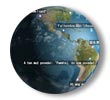 link: The Words Global Map Project, update page link: The Words Global Map Project, update page
Postscript: From anonymous to a shrinking world
Consider an analogy that can be drawn by looking at the concept of "packet data." Whenever you send an email, your message is immediately split up into hundreds and hundreds of separate pieces, called "packets." Lev Grossman, writing in "Codex," describes it this way:
"To understand the idea of packet date, think of mailing a letter by ripping up a sheet of paper and tossing the bits and pieces out the window. They wend their separate ways over the Internet, moving independently, wandering from server to server, but all arrive at the same destination at the time, where they spontaneously self-assemble again into one coherent message." - LEV GROSSMAN "Codex", Harcourt Press
So is the future of missions. Thousands of messages, the words of Jesus in this case, translated into dialects and minor languages, transmitted in "packets" and assembled into the coherent tongues of a waiting world. The early disciples would marvel at this reality, and the idea that unreached distances of our world could hear these words, and find new life in a message delivered by anonymous apostles, received by an anonymous host.
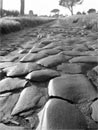 photo: The Appian Way, Rome photo: The Appian Way, Rome
Even the stones cry out praise
Is it too great of a stretch to relate this to Christ's statement that the very stones would praise God? Certainly the early church understood the relevance of stones playing part in the spread of the "Euaggelion" (good news). Beginning in the 4th century BC, the Romans undertook paving roads that crisscrossed the entire empire, meticulously cobbled roads that are still in use today, such as the Appian Way in Rome. These highways facilitated a more rapid expansion of the apostle's message. As emissaries of the teachings of Christ, they followed them to the four corners of the known world. Today, silicon is performing a similar function as it allows the gathering and delivery of this same message, one that has transcended time, reaching today to even more distant and remote locales, cultures, and peoples.
.
"The light of the body is the eye: if therefore your eye be inclined to goodness and charity, your whole body shall be full of light.." - MATTHEW 6:22 from The Sermon on the Mount
LEE CANTELON
Los Angeles, California
 smart phone major players, summer 09 smart phone major players, summer 09
Nokia "Symbian"
Research in Motion OS
Microsoft Windows Mobile
Mac OS X
Linux and Palm OS
Google "Android"
Huawei Technologies (Android-based smart phone; coming 3rd quarter of 2009)
* "Nets of silicon, webs of flesh," are the words Jennifer Cobb uses to describe the
emerging role of missions on the World Wide Web in her book "Cybergrace; The
Search for God in the Digital World" published by Crown Publishers. In her intro-
duction Cobb writes, "Many observers today see the 'hand of God' showing itself
in disparate disciplines, from artificial intelligence to the furthest realms of cyber-
space, where brute computation seems to give way to divine inspiration."
 global map project partners global map project partners

|