
HOME
PAGE
DISCOVER THE WORDS
many new languages online
The Murry
READING ROOM
inspirational reading
e-BOOKS
& AUDIO FILES
the words for your
PDA, audio
narrations, music, more
WORDS
GALLERY
art that amplifies The Words

coming
soon
THE
GREEN PRESS
products to enhance your life
ABOUT
THE WORDS
an introduction to the project
LINKS
websites we suggest

contact
us by e-mail
need
technical help?
our web team is available to
assist with technical needs

published by
THE WORDS GROUP
700 Sleater-Kinney Rd SE
No. 303-B
Lacey, WA 98503

| excerpts
from John Meacham's Newsweek article, page three "It is my deepest belief, as I am sure it is yours, that all who ever breathe life on this Earth are children of God and my most binding obligation to them, as a brother in this waking world, is to love them" - Mel Gibson The surprising alliance between Gibson, as a traditionalist Catholic, and evangelical Protestants seems born out of a common belief that the larger secular world—including the mainstream media—is essentially hostile to Christianity. Finding a global celebrity like the Oscar-winning Gibson in their camp was an unexpected gift. "The Passion of the Christ," Billy Graham has said, is "a lifetime of sermons in one movie." 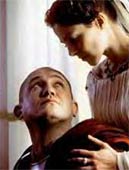 Shot
in italy, financed by Gibson, the $25 million film is tightly focused
on Jesus' final 12 hours. In the movie there are some flashbacks giving
a hint—but only a hint—of context, with episodes touching
on Jesus' childhood, the triumphant entry into Jerusalem, the Sermon
on the Mount, the Last Supper. The characters speak Aramaic and Latin,
and the movie is subtitled in English, which turns it into a kind
of artifact, as though the action is unfolding at a slight remove. Shot
in italy, financed by Gibson, the $25 million film is tightly focused
on Jesus' final 12 hours. In the movie there are some flashbacks giving
a hint—but only a hint—of context, with episodes touching
on Jesus' childhood, the triumphant entry into Jerusalem, the Sermon
on the Mount, the Last Supper. The characters speak Aramaic and Latin,
and the movie is subtitled in English, which turns it into a kind
of artifact, as though the action is unfolding at a slight remove.The arrest, the scourging and the Crucifixion are depicted in harsh, explicit detail in the movie. One of Jesus' eyes is swollen shut from his first beating as he is dragged from Gethsemane; the Roman torture, the long path to Golgotha bearing the wooden cross, and the nailing of Jesus' hands and feet to the beams are filmed unsparingly. The effect of the violence is at first shocking, then numbing, and finally reaches a point where many viewers may spend as much time clinically wondering how any man could have survived such beatings as they do sympathizing with his plight. There are tender scenes with Mary, Jesus' mother, and Mary Magdalene. "It is accomplished," Jesus says from the cross. His mother, watching her brutally tortured son die, murmurs, "Amen." In the battle over his project, Gibson has veered between defiance and conciliation. "This film collectively blames humanity [for] the death of Jesus," he said in his Global Catholic Network interview. "Now there are no exemptions there. All right? I'm the first on the line for culpability. I did it. Christ died for all men for all times." Of critics who think his film could perpetuate dangerous stereotypes, he said: "They've kind of, you know, come out with this mantra again and again and again. You know, 'He's an anti-Semite.' 'He's an anti-Semite.' 'He's an anti-Semite.' 'He's an anti-Semite.' I'm not." In a letter to Anti-Defamation League national director Abraham Foxman last week, Gibson wrote: "It is my deepest belief, as I am sure it is yours, that all who ever breathe life on this Earth are children of God and my most binding obligation to them, as a brother in this waking world, is to love them." In the best of all possible worlds, "The Passion of the Christ" will prompt constructive conversations about the origins of the religion that claims two billion followers around the globe, conversations that ought to lead believers to see that Christian anti-Semitism should be seen as an impossibility—a contradiction in terms. To hate Jews because they are Jews—to hate anyone, in fact—is a sin in the Christian cosmos, for Jesus commands his followers to love their neighbor as themselves. On another level, anti-Semitism is a form of illogical and self-defeating self-loathing. Bluntly put, Jesus had to die for the Christian story to unfold, and the proper Christian posture toward the Jewish people should be one of respect, for the man Christians choose to see as their savior came from the ancient tribe of Judah, the very name from which "Jew" is derived. As children of Abraham, Christians and Jews are branches of the same tree, linked together in the mystery of God. Let us end where we, and Gibson's movie, began—in the garden, in darkness. The guards have come to arrest Jesus. He watches as his disciples come to blows with the troops. Punches are thrown, and one of Jesus' men lashes out with a weapon, slashing off the ear of a servant of the high priest. Watching, removed from the fray, Jesus intervenes, commanding: "Put up thy sword," making real the New Testament commandment to love one another as he loved us, even unto death—a commandment whose roots stretch back to the 19th chapter of Leviticus: "... you shall love your neighbor as yourself; I am the Lord." Amid the clash over Gibson's film and the debates about the nature of God, whether you believe Jesus to be the savior of mankind or to have been an interesting first-century figure who left behind an inspiring moral philosophy, perhaps we can at least agree on this image of Jesus of Nazareth: confronted by violence, he chose peace; by hate, love; by sin, forgiveness, a powerful example for us all... back  |